

Nationwide large-loss support
Moisture mapping and monitoring built for complex property losses.
Independent field documentation, repeat monitoring, environmental assessment, and clear reporting for restorers, adjusters, consultants, owners, and property teams.

What to send for a rapid scope review
Property and loss
City and state, property type, approximate square footage, loss date, affected areas, and current site conditions.
Decision and deadline
What the documentation needs to support, which parties will use it, and any walkthrough, reserve, or reporting deadline.
Access and safety
Site access, operating hours, PPE or clearance requirements, known hazards, and the best onsite contact.
A practical large-loss workflow
- Scope review. BIS reviews the loss, property, stakeholders, travel, access, safety, and required deliverables.
- Mobilization plan. Staffing and arrival timing are confirmed for the specific assignment. Urgent catastrophe work is prioritized, but timing depends on the facts of the project.
- Baseline documentation. The team records visible conditions, moisture data, affected materials, photos, and relevant field observations.
- Mapping and monitoring. Moisture locations are mapped and, when requested, monitored over time so changing conditions can be compared.
- Decision-ready reporting. Findings are organized for the people coordinating mitigation, scope, reserves, repair, and claim decisions.
Clear field documentation
Maps show where observations were made—not more than the data supports.
Moisture conditions can change after a loss and during drying. BIS reports the conditions observed at the time of each visit, notes relevant limitations, and identifies areas that may need further investigation by the appropriate contractor or consultant.
The goal is to give materially interested parties a useful common reference without presenting an observation as a result that was never established.
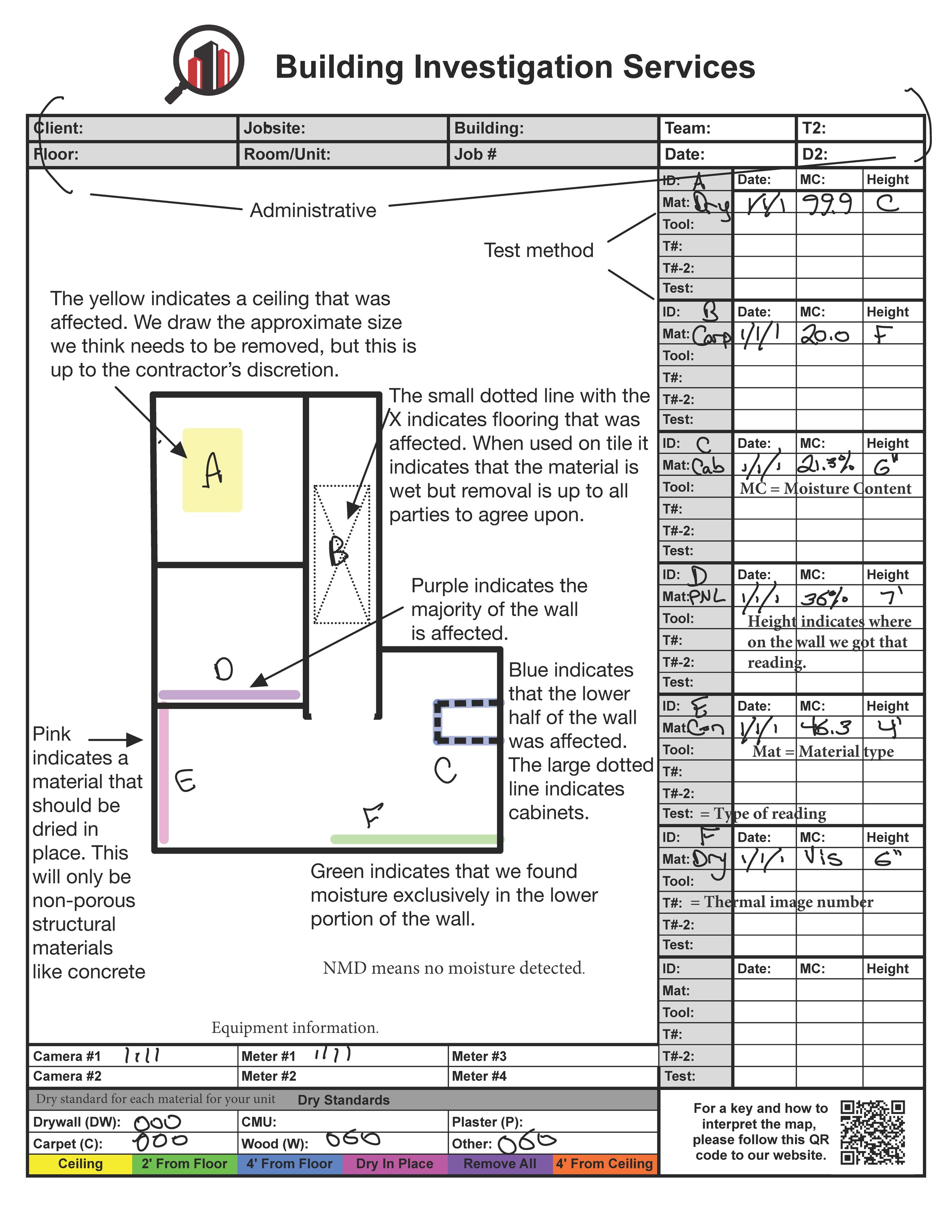
Typical deliverables
- Baseline condition and affected-area documentation
- Annotated moisture maps and floor-plan references
- Photographs tied to observed conditions
- Moisture readings and monitoring comparisons
- Environmental sampling results when included in scope
- Written observations, limitations, and next-step considerations
- Progress reporting for defined monitoring intervals
- Final reporting organized for project stakeholders
Project experience described by our clients
These summaries are based on published client testimonials. They describe the assignment and client experience; they do not reproduce measured readings or laboratory findings.
Tornado loss · May 2024
Rogers, Arkansas: approximately 250,000 square feet
Concern: The client described tornado damage, a power outage, and a walkthrough scheduled days after the event.
Investigation: According to the client, BIS arrived the next day after being called, checked moisture throughout the building, and helped develop a demolition scope.
Reported outcome: The client praised the documentation and described a happy customer.
Repeated large projects
At least five losses over 100,000 square feet
Assignment: Daniel P. Burgdorf, a restoration-company executive, described using BIS on multiple complex losses.
Work: His account cites condition assessment, moisture mapping, environmental guidance, and reports for project stakeholders.
Client perspective: He emphasized clear, detailed information that the team could act on.
Fire-related assessment
Combustion-byproduct sampling
Concern: An industrial hygiene firm needed information about the extent of fire-related damage.
Investigation: The project manager reported hiring BIS for combustion-byproduct sampling.
Reported outcome: The client praised communication and efficient testing. Specific analytical findings were not provided in the testimonial.
For the complete accounts and their original attributions, read our large-loss client testimonials.
Built for the people coordinating the loss
Large-loss moisture-mapping FAQs
Does BIS travel nationwide?
Yes. Large-loss and catastrophe assignments may be supported nationwide. Travel, staffing, and schedule are confirmed after BIS reviews the project scope.
How quickly can a team arrive?
Urgent projects are prioritized, but arrival timing is confirmed only after reviewing staffing, travel, site access, safety requirements, and the requested deliverables. Contact BIS as early as possible for the best mobilization options.
Can BIS provide repeat moisture monitoring?
Yes. The scope can include repeat visits and comparison of documented conditions over time. The monitoring interval is established for the specific project.
Does a moisture map replace a mitigation contractor's scope?
No. BIS provides independent observations and documentation for the defined assignment. Contractors and other qualified professionals remain responsible for work methods, safety, and decisions within their own scope.
What a restoration partner says
“Their moisture maps truly feel like they should be the standard.”
— Daniel P. Burgdorf, VP Commercial/Large Loss Division, Servpro Team Thole/Hulsey; excerpt. Read the full testimonial.
Start the large-loss scope review.
Share the property location, approximate size, loss date, access conditions, and the deliverables your team needs.